
DataMatrix hidden by packaging: why we built a duplicator
Extra packaging can hide the original marking code from the scanner. Here is how we solved the warehouse problem with a local Windows DataMatrix duplicator.
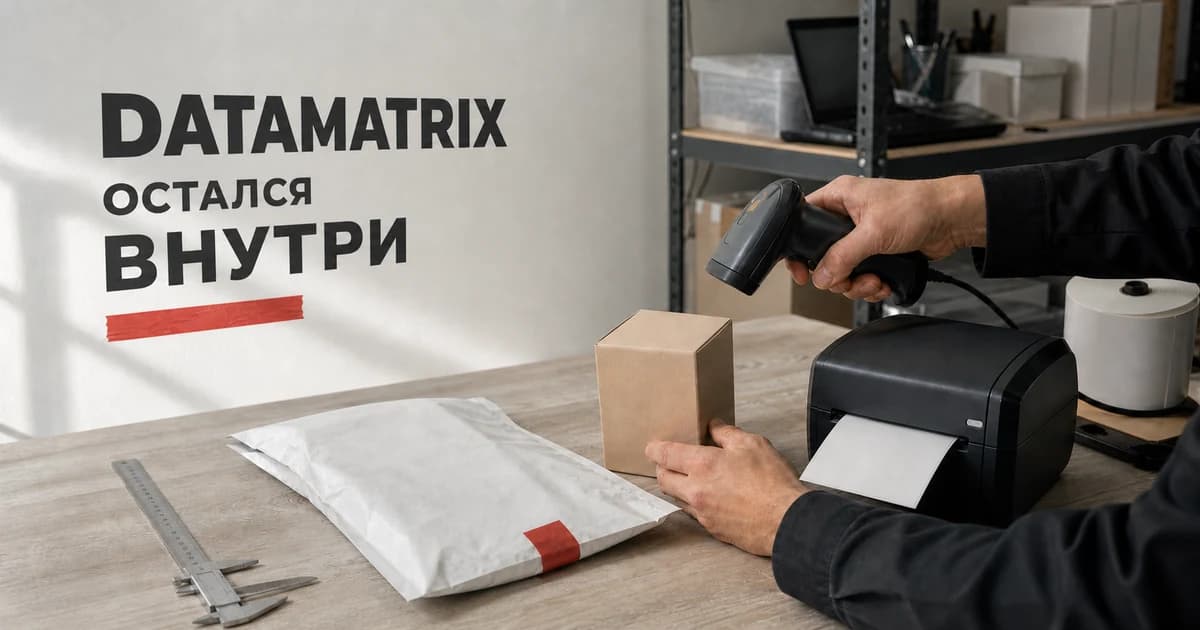
On 1 July 2026, accounting and withdrawal rules changed for some marked product groups. In FBS orders that require mandatory marking, the platform asks for DataMatrix, checks it and expects the symbol to be readable during assembly.
Marketplaces already change fulfilment procedures regularly. Government regulation has now added another layer. Complaining does not change the warehouse task. A seller who integrates the requirement into the packing process sooner spends less time reopening parcels and rebuilding orders.
We faced the same problem at K-Business. We sell through marketplaces, pack products before shipment and know how quickly an extra bag or box can hide a perfectly valid DataMatrix.
Outer packaging can hide the original DataMatrix
The product already has a valid marking code. It is readable, has the correct status and belongs to a specific item. Then an operator places the product in a bag, box or bubble wrap. The original DataMatrix stays inside.
Wildberries states in its FBS instructions that when a marking symbol cannot be read through the outer layer, it should be placed visibly on the outer packaging. In warehouse terms, the task is straightforward: scan the original code and print the same image outside.
Both images refer to the same item. The application does not issue a new code and does not transfer an existing code to another product.
A DataMatrix cannot be copied as ordinary text
DataMatrix looks like a small square, but the payload is more complicated. A complete marking code may contain a GTIN after application identifier 01, a serial number after 21, verification key 91, crypto tail 92 or 93, and invisible GS separators.
The structure and length vary between product groups. GS separators are invisible to a person, but a system may reject the code without them. Wildberries warns that these characters are often lost when a code is copied from a spreadsheet or document.
A duplicator therefore has to preserve the full scan result, including service characters, and print the same code without rebuilding it. Supporting different DataMatrix structures took most of the development work.
How we interpret duplicate printing
On 13 July 2026, Chestny ZNAK published direct guidance for cosmetics, household chemicals and personal-care products. To preserve the integrity of secondary or tertiary packaging, a duplicate image of the unique identifier from the consumer packaging may be placed on the outside. The participant chooses the location while following the applicable marking rules.
If the seller is not the manufacturer or importer and did not receive the original marking-code files from the system, the seller performs the duplication independently. The CRPT operator does not separately regulate this process. This is the exact workflow for which we built the application.
Other product groups remain subject to their own rules. Chestny ZNAK also publishes direct repeat-printing guidance for dairy products and tyres. If a product group's rules expressly prohibit repeated placement, this mode must not be used.
The operating boundary is clear:
- the original code must be readable and belong to the item being packed;
- the duplicate is placed on the outer packaging of that same item;
- one code must not be printed for several products;
- a lost or damaged code requires remarking, not an ordinary duplicate.
The application prints an exact copy. It does not change the code status or the legal rules governing the product.
Similar applications already exist
This is not an empty market. Some utilities take a scan and send it directly to a printer. Others combine duplicate printing with a label editor and product catalogue. Large warehouse systems cover the full FBS assembly process.
I did not compare our application with every tool on the market. We needed a local Windows workstation where an operator could see the product, code and final label in one window. Deploying a large warehouse system for one operation made little sense for us.
The first version was built for K-Business and our clients. We then saw that any seller using extra packaging can run into the same problem, so we decided to make the application available to everyone.
Two working modes cover different labels
In simple mode, the operator scans the original code and prints only DataMatrix. This is enough when the outer package needs a readable copy of the marking symbol.
In marketplace mode, DataMatrix becomes part of a larger label. Selected fields from the product catalogue can be added: product name, GTIN, seller SKU, linear barcode and marketplace data.
| Mode | Printed content | Use case |
|---|---|---|
| Simple | Exact DataMatrix copy only | The outer package needs an accessible marking symbol |
| Marketplace | DataMatrix and selected label fields | Marking and order data should appear on one label |
Both modes use the same principle: the application prints the scanned code and never invents a new one.
The main screen follows the operator's workflow
I divided the interface into three work areas. The left side handles scanning, counters, the last code, repeat printing and the activity log. The centre shows the label preview. The right side controls dimensions, fields and element positions.
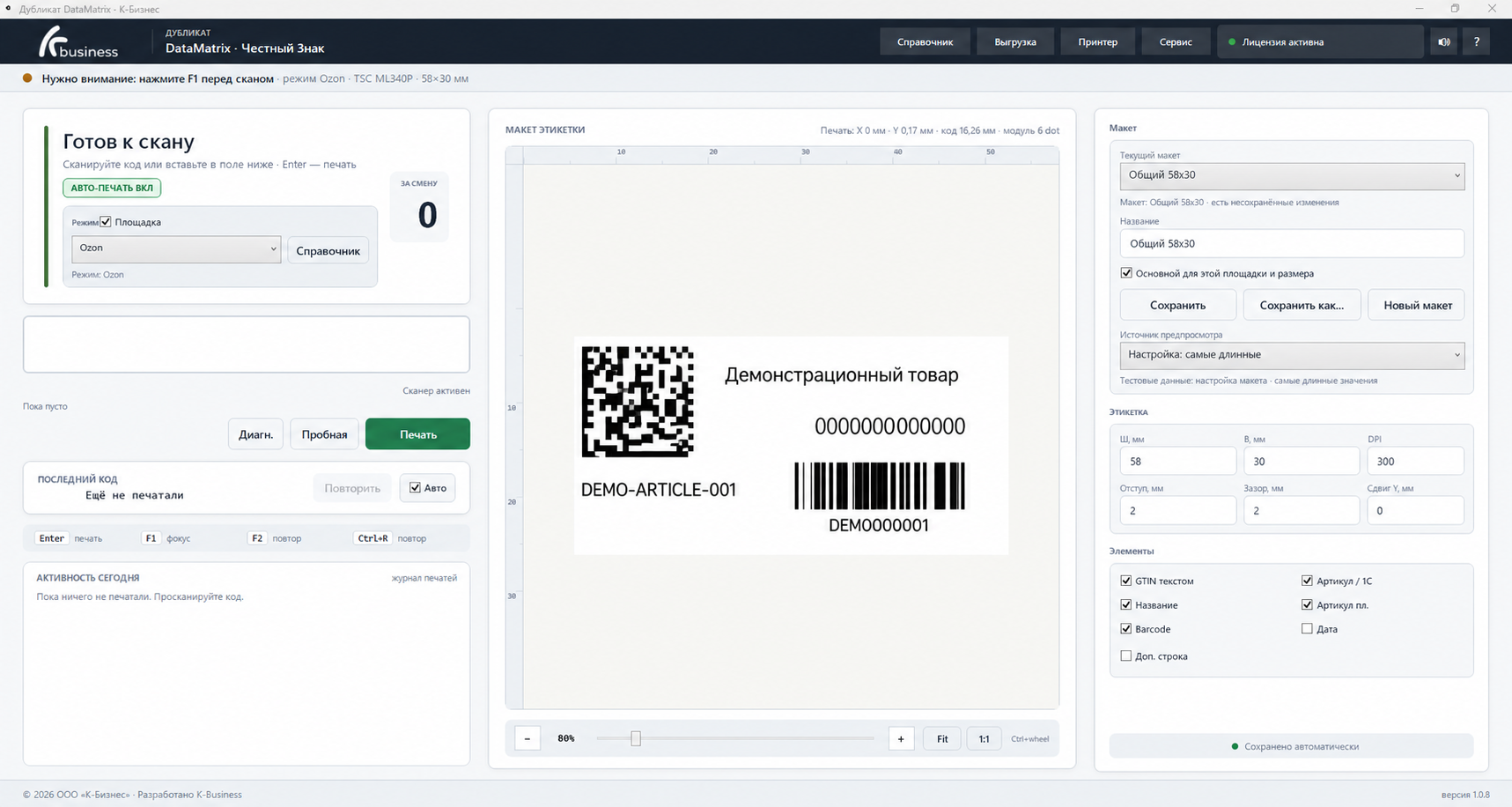 Dublikat DataMatrix main screen: scanning on the left, label preview in the centre and layout controls on the right
The operator does not have to switch between a separate duplicator, a label editor and a spreadsheet. The product catalogue is built in: enter a product once, then reuse its fields in label layouts.
We tested codes from several product groups
The application is not tied to cosmetics. I tested it with codes for dairy products, canned foods, dietary supplements, sports nutrition and other groups. Different structures and separators are why the initial idea of simply scanning and printing a square required much more work.
Physical printing was tested on TSC and Godex printers. Other models require a correct Windows driver, the right label size and a supported printer language.
Repeat printing is recorded
An operator may need another label because the first one was damaged, applied incorrectly or discarded. The application asks for a reason and saves the action in its log.
This does not prevent every possible mistake, but it removes an uncontrolled print-again button. A supervisor can see what happened at the workstation and why a repeat appeared.
Data remains on the local computer. The application checks for updates and offers to install a new version, so users do not have to search the website for a fresh installer.
The trial lasts 90 days
The application can be downloaded from the Dublikat DataMatrix product page and tested with a seller's own scanner, printer and labels. The trial lasts 90 days. Continued use after that requires a licence.
Regular K-Business clients and partners receive the licence free of charge. We treat the application as part of the service provided to companies that work with us continuously.
The next step is a Chestny ZNAK workstation
The next project is broader than duplicate printing. I want to build a workstation for codes, orders and other Chestny ZNAK operations so that warehouse staff have fewer manual steps.
A shared organisation database is also on the roadmap: several computers, one product catalogue and a common activity history. Cloud mode will stay disabled until organisation data can be isolated safely and access can be controlled properly. The application itself will announce the update when this work is ready.
Download and try Dublikat DataMatrix
Ivan Viktorovich Kondrashov, Technical Director at K-Business LLC
Reviewed on 14 July 2026. Sources: Russian Government Resolution No. 656, Wildberries FBS labelling instructions, Wildberries code verification instructions, Ozon mandatory marking guidance, and Chestny ZNAK community materials on duplicate printing.
Need import guidance?
Get a compliance-ready plan for your product.
FAQ
What should a seller do when DataMatrix is hidden by extra packaging?
For cosmetics, household chemicals and personal-care products, Chestny ZNAK explicitly allows a duplicate image of the original identifier on the outer packaging of the same item. Other product groups remain subject to their own rules. One code must never be used for different items.
Does the application generate new marking codes?
No. Dublikat DataMatrix reads an existing code and prints an exact copy. Ordering and issuing new codes remains a function of the Chestny ZNAK system.
How can I try Dublikat DataMatrix?
The Windows application is available on the K-Business website with a 90-day trial. Regular K-Business clients and partners receive the licence free of charge.
Author
Кондрашов Иван ВикторовичSee also

Compliant Importers Will Take the First Hit. Here Is Why
SPOT, Chestny ZNAK and marketplaces are beginning to see the same product. Sergey Maltsev explains why compliant importers will feel it first.

SPOT for Korean Cosmetics: When an EAEU Route Changes Timing and Cash Flow
How SPOT affects cosmetics moved by road through the EAEU: DOPP, QR code, security payment, and why direct imports from Korea follow a different route.
Cosmetics Labelling in Russia in 2026: What to Check Before Import
Which products require labelling, when to apply Data Matrix codes to imports from Korea, and how to take a shipment from product card to circulation.
Import Duty on Korean Cosmetics in Russia: 6.5% or 35%?
The Russian import duty on Korean cosmetics depends on the EAEU HS code: 6.5% for skincare and selected products, but 35% for shampoos and hair sprays.